There shouldnt be x11/xorg nor xwayland, either wayland or no land.
Otherwise we gonna face the loop of legacy and unwanted vulnerabilities.
There shouldnt be x11/xorg nor xwayland, either wayland or no land.
Otherwise we gonna face the loop of legacy and unwanted vulnerabilities.
Will be considered during: port to Wayland - Development - Whonix Forum
For the Trixie port, removing Xwayland does not look possible without switching to a resource-heavy desktop environment or using hacks:
The only options I can see moving forward are:
Further research into making a fake XWayland binary will probably occur, but we should be ready for this to not work.
Also, spice-vdagent (which provides clipboard sharing and mouse integration under KVM) requires XWayland to be running in order to function. Theoretically we could document how to enable XWayland for users who depend on those features, but in general, not having them is a serious usability issue. (We’re facing similar issues with VirtualBox, which still needs investigation.)
from my perspective all of the above desktop environments are moving towards Wayland support in a relatively good way. We don’t like GNOME because of previous privacy concerns, and we don’t like KDE because of resource consumption. The other two we could live with, the only reason we can’t live with XFCE is because the developers aren’t all that fast at porting since they have lives to live too.
I thought about Budgie, but 10.9 only has preliminary (i.e. experimental) Wayland support, which insinuates it will probably be as rough or worse than XFCE in Trixie.
I’m not sure how much of this is unfounded supersition and how much of it is reasonable wariness, but Kylin and Kylin-related projects scare me. Kylin (which openKylin is the open-source variant of) ss state-funded by China as I understand it, and China’s current government is, to put it mildly, not particularly well-known for its commitment to privacy or user freedom. I don’t necessarily mind using software that is Chinese in origin if it’s well-respected by the global community, but something state-sponsored… it’s kind of like using encryption algorithms designed by the NSA; even if they look good on the surface, there’s probably a backdoor. I fear the same could be true here too.
This fear is further enhanced by the fact that another Linux desktop environment with ties to the Chinese government, Deepin, was removed from openSUSE because of a mixture of semi-malicious packager behavior and the code being a security disaster under the hood. I don’t have any particular reason to trust Kylin more than Deepin, and wouldn’t be surprised if the code was similarly horrible.
Aside from the privacy and security concerns, I’ve used Kylin very briefly doing testing for Ubuntu, and found the English in several spots to be too broken to be comfortably usable. Since Kicksecure and Whonix are primarily targeted towards English-speaking users, I don’t think this would be a good fit.
Thats what i shortcut into one word.
Awesome then, i had the same conclusions.
If LXQt with dummy xwayland will work, not a bad idea, nice workaround.
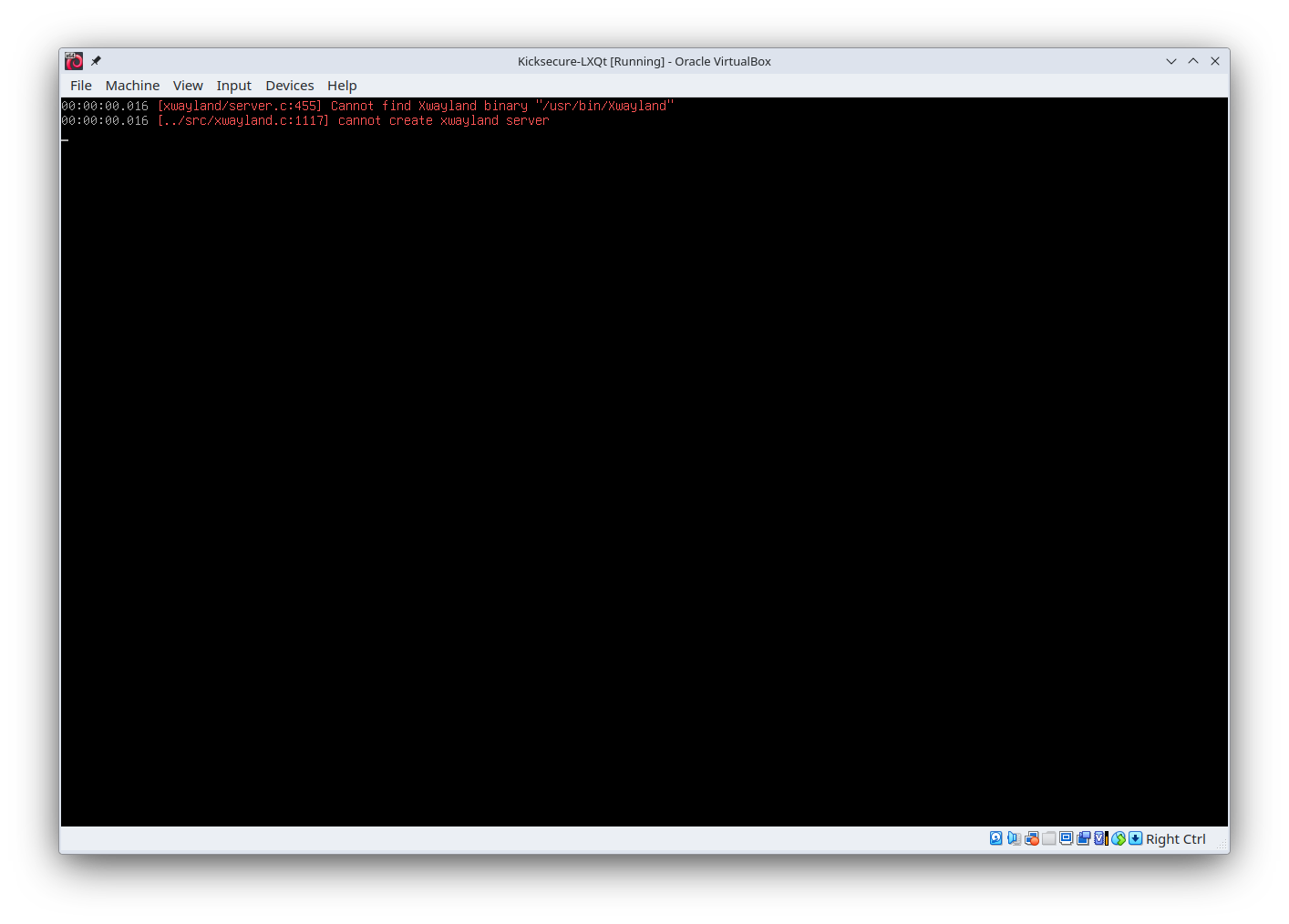
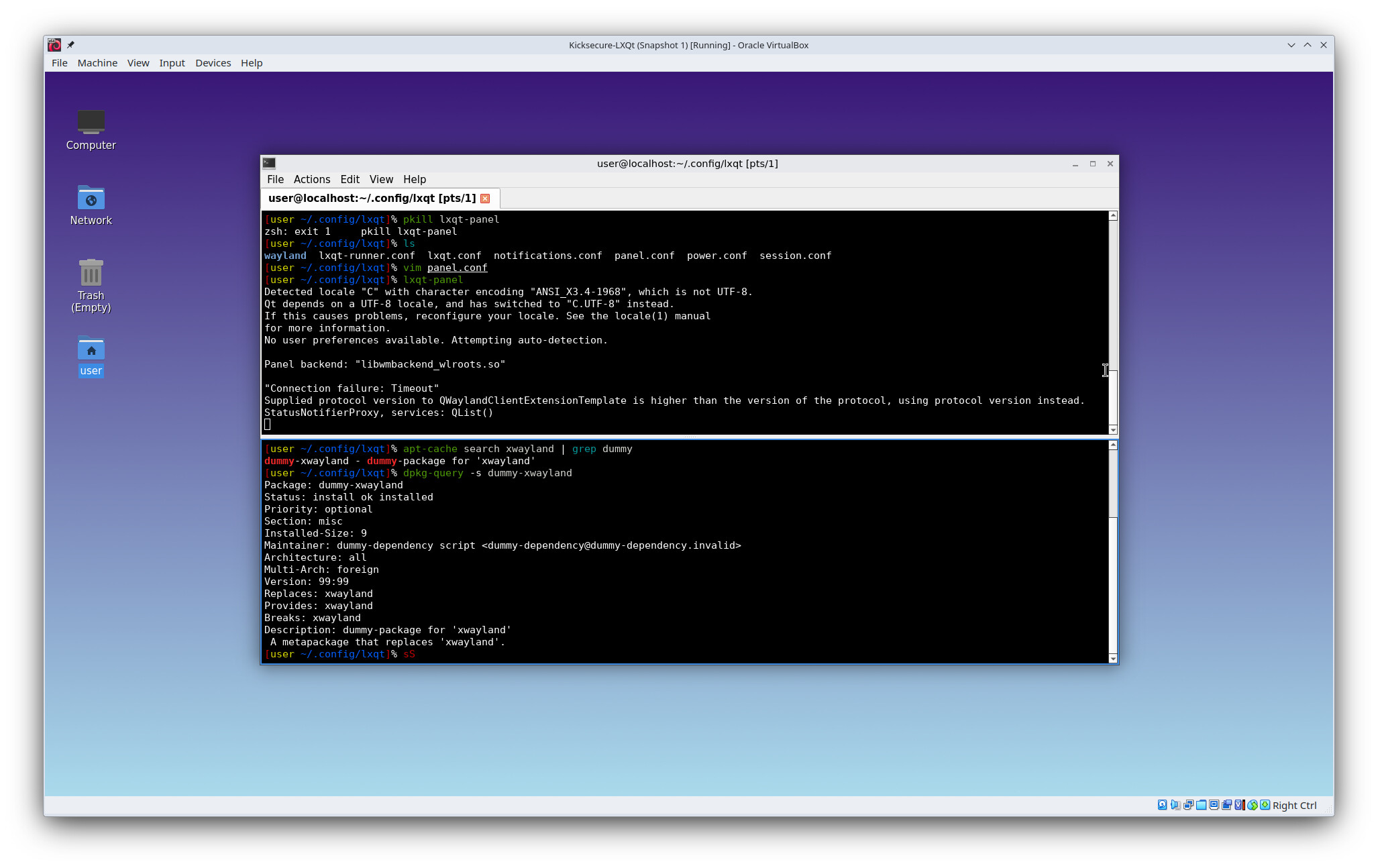
Well, I tried dummy Xwayland, and it almost worked…
Note the panel is missing. It actually does show up eventually but it requires a configuration change to get it to appear (or so it seems), it’s frozen when it appears, it takes a good few minutes for it to appear, it lags heavily, and it’s otherwise not usable. labwc itself doesn’t seem to have any issues with the setup, and a lot of the rest of LXQt is fine with it, but the panel is not happy at all. Not sure what part of it is using X11, but something’s using it, or so it seems… After it finishes freezing intermittently for several minutes, it works pretty well.
The /usr/bin/Xwayland binary is literally just:
#!/bin/bash
sleep infinity
I think we’re going to have to go with Xwayland at least this development cycle. It’s still a major step in the right direction even if we haven’t reached perfection yet.
Is there any way to restrict KDE or GNOME? You’ve already implemented user separation, and Sysmaint severely limits the system. Maybe now KDE could be a great option, which would put an end to all the Wayland issues. I understand that desktop minimalism is very important, but how suitable is LXQt for Linux users who mainly use GNOME and KDE now? And how important is resource consumption compared to the security of Wayland when separating users? It could save you a lot of time by not having to reinvent solutions with the unpopular and inconvenient LXQt.
This is the development sub-forum.
Before participating in a development discussion, please ensure you have thoroughly reviewed the entire thread. For example, a link to https://forums.whonix.org/t/port-to-wayland/17380 was already provided, where the topic of GNOME/KDE is explicitly discussed.
From that thread:
It’s probably not a port to GNOME. Reasons: Dev/GNOME - Whonix
That link now redirects to:
Reading that page alone should make it clear why GNOME is not being considered.
This will be formalized here:
Development Discussion Expectations
part of Calamares without XWayland:
Related… Port to Wayland was done in version 18.
xwayland not installed by default in debian lxqt forky/14, so lxqt has no dependency on xwayland.
But something to note here is that Virtualbox and Nvidia (and probably others) are still rely on some of x11 packages, so installing them will lead to installing x11 packages. Good thing there are alternatives to them like virt-manager and ..etc, just make sure to choose your software properly (report to these projects to upgrade their software).